
Introduction
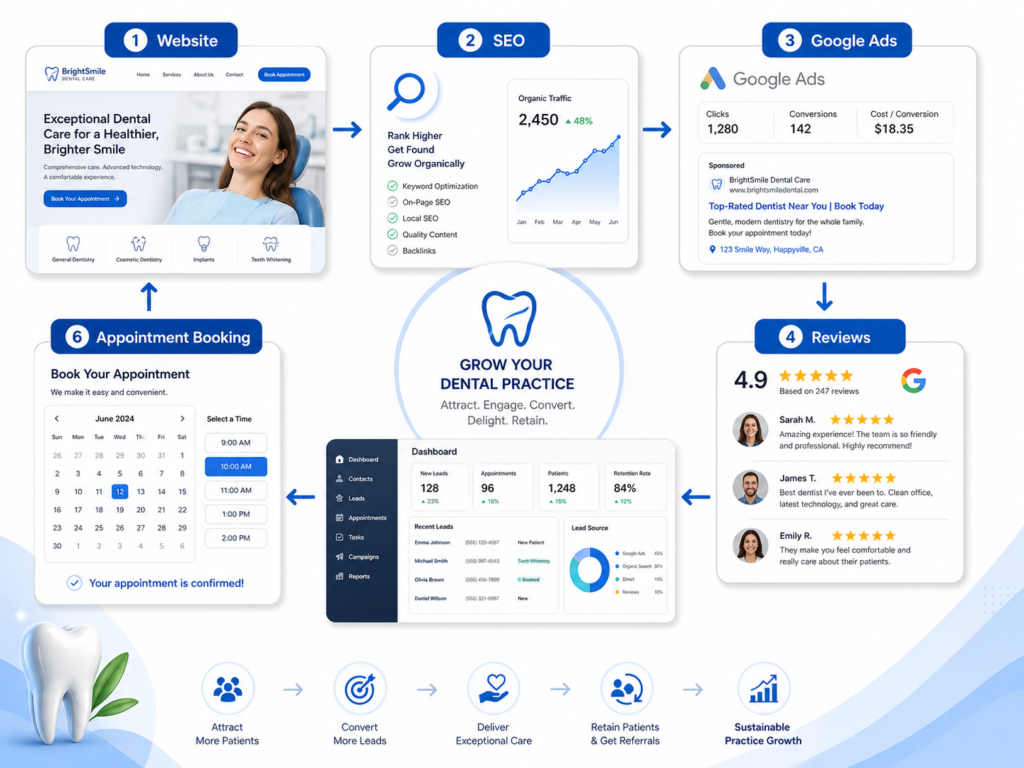
A digital marketing strategy for dentists is not just about posting on Instagram or running random Google Ads. It is about building a clear system that helps your clinic get found, build trust, generate enquiries, and convert those enquiries into booked appointments.
Most dental clinics do not have a marketing problem. They have a system problem.
They may have a website, a Google Business Profile, some ads, and social media pages. But these things are often disconnected. The website does not convert well. Reviews are not collected consistently. Ads are not tracked properly. Follow-ups are manual. And nobody knows which channel is actually bringing patients.
That is why dentists need a practical, measurable, and patient-focused dental marketing strategy.
This guide will help you understand how to build one properly.
Table of Contents
- What Is a Digital Marketing Strategy for Dentists?
- Why Dentists Need a Clear Online Marketing System
- Build a High-Converting Dental Website
- Use Local SEO for Dentists to Attract Nearby Patients
- Optimize Your Google Business Profile
- Run Google Ads for High-Intent Dental Leads
- Use Content Marketing to Build Trust
- Collect Reviews and Improve Online Reputation
- Add CRM, Automation, and Follow-Up Systems
- Track Performance and Improve Every Month
- Conclusion
- FAQs
- Final CTA
What Is a Digital Marketing Strategy for Dentists?
A digital marketing strategy for dentists is a step-by-step plan to attract, educate, and convert potential patients using online channels.
It includes your website, dentist SEO, Google Business Profile, paid ads, social media, reviews, email follow-ups, WhatsApp reminders, CRM, and analytics.
The goal is simple: make it easy for the right patient to find your clinic, trust you, and book an appointment.
A Good Dental Strategy Connects Everything
Many dentists treat each marketing channel separately.
One person handles Instagram. Another runs ads. Someone else manages the website. Reviews are requested only when the team remembers.
This creates gaps.
A strong dental marketing strategy connects all important touchpoints:
- Search visibility
- Website experience
- Appointment booking
- Patient follow-up
- Review generation
- Remarketing
- Reporting
When these pieces work together, marketing becomes predictable.
Why Dentists Need a Clear Online Marketing System
Dental patients do research before booking.
They search for treatments, compare clinics, read reviews, check before-and-after images, look at location, and then decide whom to contact.
So your online presence must answer three questions quickly:
- Are you near me?
- Can I trust you?
- Can I book easily?
If your website is slow, your reviews are weak, your Google profile is incomplete, or your ads lead to a poor landing page, you lose potential patients.
Marketing Is Not Just Visibility
Visibility alone is not enough.
A dental clinic may get traffic but still receive very few appointments. This usually happens because the clinic has not built a proper dental appointment booking funnel.
A funnel means the patient journey is planned:
Search → Click → Website/Landing Page → Trust Builder → Enquiry → Follow-Up → Appointment → Review
That is the real job of digital marketing for dentists.
Build a High-Converting Dental Website
Your website is the centre of your online marketing system.
It should not be just a digital brochure. It should work like a patient conversion tool.
A good dental website must clearly show your services, location, doctor profile, treatment process, patient reviews, appointment options, and contact details.
Website Pages Every Dental Clinic Needs
At minimum, your dental clinic website should include:
- Homepage
- About the dentist
- Services pages
- Location page
- Contact page
- Appointment booking page
- Reviews/testimonials page
- Blog section
Each treatment should ideally have a separate page.
For example:
- Dental implants
- Teeth whitening
- Root canal treatment
- Braces and aligners
- Smile designing
- Pediatric dentistry
- Emergency dental care
This helps both users and search engines understand your services better. Google’s SEO documentation explains that SEO helps search engines crawl, index, and understand site content more effectively.
Improve Website Conversion
Your website should have strong calls-to-action.
Use buttons like:
- Book an Appointment
- Call the Clinic
- Get Treatment Cost Estimate
- WhatsApp Us
- Schedule Consultation
Also, place contact options above the fold, especially on mobile.
Most patients searching for dentists are ready to act. Do not make them hunt for your phone number.
Use Local SEO for Dentists to Attract Nearby Patients
Local SEO for dentists is one of the most important parts of dental marketing.
When someone searches “dentist near me” or “root canal specialist in [city],” your clinic should have a chance to appear in local search results.
This is where dentist SEO becomes valuable.
Focus on Location-Based Keywords
Instead of targeting only broad keywords like “dental implants,” target local keywords like:
- dental implants in Mumbai
- dentist in Andheri
- root canal treatment in Delhi
- best orthodontist near me
- emergency dentist in Bangalore
These keywords show local intent.
The person is not just learning. They are likely looking for a clinic.
Create Service + Location Pages
A smart SEO structure for a dental clinic looks like this:
/dental-implants-in-city/root-canal-treatment-in-city/teeth-whitening-in-city/braces-in-city/emergency-dentist-in-city
Each page should include treatment details, benefits, process, FAQs, dentist credentials, reviews, pricing guidance if possible, and appointment CTA.
This makes your dental clinic marketing more targeted. Google SEO Starter Guide
Optimize Your Google Business Profile
Your Google Business Profile is critical for local patient acquisition.
For many dentists, it may be more important than social media because it appears when people are actively searching for nearby dental care.
A strong profile should include accurate business name, address, phone number, clinic hours, services, photos, appointment link, and regular updates.
What to Add to Your Google Business Profile
Add these details properly:
- Clinic name
- Correct category
- Phone number
- Website link
- Appointment link
- Opening hours
- Treatment services
- Clinic photos
- Dentist photos
- Patient-friendly updates
- FAQs
- Reviews
Google has also moved toward stronger verification and trust signals for local businesses; for example, Local Services Ads require verified Business Profiles in supported regions.
Reviews Matter a Lot
Patients trust other patients.
A clinic with strong reviews, detailed feedback, and recent activity will usually create more trust than a clinic with no review strategy.
Ask happy patients for reviews after successful treatment.
Do it ethically. Do not offer money, discounts, or gifts in exchange for reviews. Google has policies against fake or incentivized reviews, and fake review activity can create serious trust issues for businesses.
Run Google Ads for High-Intent Dental Leads
Google Ads for dentists can work very well when used properly.
The advantage is intent.
Someone searching “dental implant clinic near me” or “emergency dentist open now” is much closer to booking than someone casually scrolling on social media.
But ads can become expensive if there is no strategy.
Use Separate Campaigns by Treatment
Do not run one generic campaign for all dental services.
Create focused campaigns for:
- Dental implants
- Emergency dental care
- Invisalign or aligners
- Teeth whitening
- Smile designing
- Root canal treatment
- Pediatric dentistry
Each campaign should have its own keywords, ad copy, and landing page.
This improves relevance and conversion.
Landing Pages Are More Important Than Traffic
Sending ad traffic to a weak homepage is a common mistake.
For paid ads, create dedicated landing pages.
A good dental landing page should include:
- Clear treatment headline
- Benefits
- Doctor credentials
- Before-after visuals, where compliant
- Patient reviews
- Clinic location
- Appointment form
- Call and WhatsApp buttons
- FAQs
- Trust signals
Paid ads should not only generate clicks. They should generate qualified appointments.
Use Content Marketing to Build Trust
Dental patients often have questions before they book.
They want to know if a procedure is painful, how much it costs, how long it takes, and whether it is safe.
This is where dental content marketing helps.
Blog Topics Dentists Can Create
Useful blog topics include:
- Is root canal treatment painful?
- Dental implants vs bridges: which is better?
- How long does teeth whitening last?
- When should you visit an emergency dentist?
- Braces vs clear aligners: what should you choose?
- How to choose the right dentist near you?
These topics attract people during the research stage.
Not every reader will book immediately. But helpful content builds trust and keeps your clinic visible.
Use Video and Short-Form Content
Dentists can also use video content for education.
Simple videos can explain:
- Treatment process
- Myths and facts
- Post-treatment care
- Clinic walkthrough
- Dentist introduction
- Patient FAQs
This makes the clinic feel more human.
People are more comfortable booking when they have already seen the dentist explain things clearly.
Collect Reviews and Improve Online Reputation
Your online reputation directly affects patient decisions.
A patient may find you through SEO or ads, but before booking, they will usually check your reviews.
That is why review generation should be a system, not a random activity.
Create a Review Request Process
After treatment, your front desk or CRM can send a polite review request.
For example:
“Thank you for visiting our clinic. We hope your experience was comfortable. Your feedback helps other patients make better decisions. Please share your review here.”
Keep it simple.
Do not pressure patients. Do not write reviews on their behalf. Do not use fake reviews.
Respond to Reviews Professionally
Reply to both positive and negative reviews.
For positive reviews, thank the patient.
For negative reviews, stay calm, professional, and privacy-conscious. Avoid discussing medical details publicly. Healthcare providers should be careful with patient information, and HIPAA sets standards for protecting sensitive health information in the United States.
Even outside the US, the principle is simple: protect patient privacy.
Add CRM, Automation, and Follow-Up Systems
Many dental clinics lose leads because follow-up is weak.
Someone fills out a form. Nobody calls quickly. A WhatsApp message is missed. A patient asks for pricing and then disappears.
This is where CRM and automation help.
What a Dental CRM Should Track
A basic CRM for dental clinics should track:
- New leads
- Source of enquiry
- Treatment interest
- Call status
- Appointment status
- Follow-up date
- No-shows
- Converted patients
- Repeat visits
This gives the clinic visibility.
You can see which channel brings leads, which leads convert, and where the process is breaking.
Automate Simple Follow-Ups
Automation can support the team without replacing human care.
You can automate:
- Appointment reminders
- Missed call follow-ups
- Consultation reminders
- Post-treatment care messages
- Review requests
- Revisit reminders
- Lead nurturing messages
For example, if someone enquires about dental implants but does not book, you can send educational follow-ups explaining the process, benefits, FAQs, and consultation options.
That is smart dental lead generation.
Track Performance and Improve Every Month
A digital marketing strategy for dentists must be measured.
Without tracking, you are guessing.
You need to know what is working and what is wasting money.
Important Metrics to Track
Track these numbers monthly:
- Website traffic
- Google Business Profile calls
- Direction requests
- Form submissions
- Call enquiries
- WhatsApp enquiries
- Cost per lead
- Appointment booking rate
- No-show rate
- Treatment conversion rate
- Revenue by marketing channel
The goal is not just more leads.
The goal is more quality appointments and profitable treatments.
Improve Based on Data
If SEO traffic is growing but enquiries are low, improve website conversion.
If ads generate leads but bookings are poor, improve follow-up.
If Google Business Profile views are high but calls are low, improve reviews, photos, and service details.
Marketing improves when you review the full system, not just one channel.
Conclusion
A strong digital marketing strategy for dentists is built on clarity, trust, and systems.
You need a website that converts, local SEO for dentists that attracts nearby patients, a complete Google Business Profile, focused Google Ads, useful content, strong reviews, and a CRM-backed follow-up process.
Do not depend on one channel.
SEO builds long-term visibility. Ads bring faster enquiries. Reviews build trust. Automation improves follow-up. Content educates patients. CRM helps you track everything.
When these pieces work together, your dental clinic does not just get more online attention. It gets a more predictable patient acquisition system.
That is the real purpose of a digital marketing strategy for dentists.
FAQs
1. What is the best digital marketing strategy for dentists?
The best digital marketing strategy for dentists includes local SEO, a strong dental website, Google Business Profile optimization, Google Ads, patient reviews, content marketing, CRM, and automated follow-ups.
2. Do dentists need SEO?
Yes. Dentist SEO helps dental clinics appear when people search for treatments, dentists near them, or specific dental services in their city.
3. Are Google Ads useful for dentists?
Yes. Google Ads for dentists can generate high-intent leads because people searching on Google are often ready to book or compare clinics.
4. How can dentists get more patients online?
Dentists can get more patients online by improving local SEO, collecting reviews, running treatment-specific ads, creating helpful content, and using a CRM to follow up with every enquiry.
5. How important are reviews for dental clinics?
Reviews are very important because dental patients want trust before booking. Recent, genuine, and detailed reviews can improve confidence and increase appointment enquiries.
6. Should dentists use social media marketing?
Yes, but social media should support trust-building. It works best for education, dentist introductions, patient awareness, treatment explanations, and clinic branding.
7. What should a dental clinic website include?
A dental website should include treatment pages, doctor profile, reviews, location, appointment booking, contact buttons, FAQs, photos, and clear calls-to-action.
Final CTA
Need a practical marketing system for your dental clinic?
Start with a clear audit of your website, Google Business Profile, SEO, ads, reviews, and follow-up process. Once you know where patients are dropping off, you can fix the system and build a more predictable flow of enquiries and appointments.